• My favourite reads (mostly) of 2025

    I know it’s already February! But I thought it’s never too late for some book recommendations 😉

    Favourite fantasy: The Raven Scholar
    by Antonia Hodgson

    Neema Kraa is a High Scholar of the Empire — an empire with a trial-based system of power transition, where each prospective candidate is nominated by one of the animalistic gods. The trials are on. One of the candidates is murdered, and it’s up to Neema to solve the crime.
    Add to the mix: her idiosyncrasy, her entangled relationships with some of the candidates (like her ex-lover, whom she hasn’t seen for years), and the fact that she is a candidate herself — nominated by the all-knowing and magnificent Raven, a collective-mind deity who occasionally breaks the fourth wall.
    This book has it all – a lovable but insufferable heroine (to whom I might relate a bit too much), strong worldbuilding, and a good dash of yearning. And really, who doesn’t like a murder mystery that puts the entire empire at stake?

    Goodreads · StoryGraph

    Favourite sci-fi: Shroud 
    by Adrian Tchaikovsky

    This is a first-contact story disguised as space horror: workers on a planet that is about to be stripped for resources by a massive intergalactic communist corporation (yes, it combines the worst and the best of the Soviet-era communism and modern American capitalism) are left stranded in the darkness with strange creatures. To me, AT’s books always shine in how they examine the perspectives and experiences of different characters (not always human!), and how those shape their interactions and communication. If you’d like a taster of his work, I’d recommend Elder Race), a short novella with an unusual blend of fantasy and sci-fi.

    Goodreads · StoryGraph

    Favourite sequel: A Drop of Corruption
    by Robert Jackson Bennett

    This fantasy crime series follows Din, an assistant to a judge in an analogue of the Roman Empire (with a Lovecraftian twist!), and his boss, Judge Ana Dolabra. Din has perfect memory, with a tiiiiny caveat (spoilers), and Ana might have her own (not entirely human) secrets as well.
    They are sent to solve an impossible crime in one of the Empire’s most important outskirts. The main character’s voice is brilliant, and the world is both terrifying and fascinating.

    The first novel, The Tainted Cup (also by Robert Jackson Bennett), won a World Fantasy Award and was one of the best books I read in 2024.

    Goodreads · StoryGraph

    Favourite series: Dungeon Crawler Carl
    by Matt Dinniman

    If I start describing the story, it will sound bonkers and you will think me crazy for liking it as much as I do. Okay, let me try anyway:
    Imagine all buildings on Earth collapsing in one instant (thankfully, you were outside!), and a voice from the sky announcing that your planet has now been transformed into a dungeon. You are welcome to enter it and attempt to clear its floors (levels) in order to win. Your life is at stake. Your only companion is your ex-girlfriend’s diva cat. And your and your fellow crawlers’ journey will be televised to the entire galaxy.

    This series is the diamond of the LitRPG genre. I went in expecting fun and ridicule — of which it has loads — and ended up hooked on how much heart this story has. Who would have guessed that a silly book about a man and his talking cat would strike so close to how we feel in these turbulent times: fighting oppression at every step, and asking ourselves what the price is of staying ourselves and staying alive as we ascend the floors of our reality, further and further?

    Goodreads · StoryGraph (ongoing, the 8th book comes out this May).

    Best non-speculative fiction: City of Night Birds
    by Juhea Kim

    To be transparent, I am not usually drawn to non-speculative fiction. But nothing speaks to the Russian part of my soul quite like a melancholic story about a ballet dancer caught between her past and her present, her art and her love, her homeland and her sense of belonging.

    Goodreads · StoryGraph

    Favourite non-fiction: Empire of AI
    by Karen Hao

    This book documents the rise of AI as the “it” technology of today — and oh boy, is that history an utter turmoil: a tragedy; a thriller. At the core of the story is OpenAI and its founding team, and how they have shaped the technology — or rather, the roadmap of the technology that almost everyone uses nowadays, for better and for worse.

    It paints a picture of the Silicon Valley bubble where this venture was born, a world sometimes far removed from the one we live in — an ivory tower, where size and scaling and profits and visions of grandeur can matter more than real world ethics and compassion. Hao carefully lays out the true price we pay for having access to ChatGPT: data centers draining resources in the Global South; mind-harming content moderation done by underpaid workers in third-world countries; and finally, relentless and unstoppable data harvesting across the globe. All in all, it is akin to the empires of old, colonising our information and our resources, and it begs the question: how far are we willing to go in order to preserve the “convenience” of AI technology?

    Goodreads · StoryGraph

    Honourable mention: Alchemised by SenLinYu

    I’m putting this one down as an honourable mention because I first read the fanfiction Alchemised was built on back already in 2021. But it has stayed with me ever since. Yes, I love fanfiction. Yes, I know people have very polarised opinions about traditionally publishing adapted fanfic; I’m well aware that opinions on this book in particular are very divided, too.
    But before you ostracise me for loving it, hear me out. I think this book deserved to be published, because even as a fanfic, it completely surpassed the world it was based on in depth and emotion. It is brutal, and ruthless in how it engages with themes of war, the price of heroism, and what heroism even means. Perhaps I relate to these themes because I was raised in a country built in the shadow of a great war, where pure — read: manly — heroism was celebrated, and anything less was forgotten or cast aside. This book captures something deeply visceral and heartbreaking about the nature of women, particularly women caught in the tides of a war they did not want or start.
    To me, it is one of the very few books I can call a spiritual descendant of Svetlana Alexievich’s The Unwomanly Face of War.

    Goodreads · StoryGraph

    Not a book, but an honourable mention: Hazbin Hotel Season 2 came out last year!

    I feel not enough people know about it, so I have to give it a special shout-out. This animated series follows Charlie Morningstar, a princess of Hell, on her quest to introduce the concept of redemption to the sinners of her kingdom (and Heaven is skeptical).
    It’s basically a musical with absolute banger songs and a star-studded Broadway cast. It’s been a few months since it came out, and the album is still going strong in my playlist!

    IMDb: https://www.imdb.com/title/tt15599734/
    Streaming (Prime Video): Hazbin Hotel

    Not a book, but an honourable mention, Part 2: Interview with the Vampire seasons 1+2 blew my mind.

    I read Anne Rice’s classic novel at the height of my vampire obsession in 2008, when I consumed everything even remotely vampiric, and this adaptation rings closest to the source material. Jacob Anderson is phenomenal as Louis, delivering the best vampire performance I’ve seen. Sam Reid as Lestat is electrifying every time he is on screen — exactly as the character should be. Bailey Bass and Delainey Hayles are both perfect Claudias.
    The show strikes a perfect balance between portraying the monstrosity and lamenting the tragedy of being a vampire, and ultimately, accepting both the monster and the human inside each of us, vampire or not. And bonus: it is queer AF.

    IMDb: https://www.imdb.com/title/tt14921986/
    Streaming (Prime Video – AMC+ channel): Interview with the Vampire


    Let me know what your favourites were!
  • RUNNING 101: some basic biology of structured suffering

    “Seek freedom and become captive of your desires. Seek discipline and find your liberty.”

    ― Frank Herbert, Chapterhouse: Dune

    Would 15 year old myself — who skipped PE class on most of the days — have ever imagined writing this post? Probably not. I think even my 25 year old self would not believe me hyping up the grind of the running, and you know, it’s ok. One could say it is a mark of character development, served with a side of a life crisis of a millennial, and seasoned with a dash of losing control over the global narrative of events. Running has become my meditation and the time I share with my mind, my body and nature.

    I have been running on and off for around five years or so, and much more intensively and intentionally in the last two years. My poison of choice is long distance and trail running – it turns out I quite enjoy suffering in a controlled manner for a long periods of time. I started knowing almost nothing, and now I know a bit more, so I want to share my intermediate findings. I hope you find something useful for yourself!

    Disclaimer: I don’t mean to be an expert — this is a learning process for me, too, and sometimes I will simplify (but hopefully not oversimplify!) the science. It is also an excuse to draw some pretty diagrams 😉

    Biochemistry of running

    Before I get into the bits about training, l will review the chemistry of running (exercise, in general) which would then tie into various training interventions and hopefully help with their understanding.

    Running requires energy. Energy, in the language of the body chemistry, is the ATP molecule (adenosine triphosphate). As the name suggests, it contains one adenosine group, and three phosphate groups. Muscle contraction necessary for running (and many other activities) happens via the help of a myosin. It is a small protein basically driving the contraction, which belong to a class of motor proteins. If you ever studied anything to do with biology, you must have seen the famous walking gif of a related motor protein kinesin:

    A kinesin molecule carrying a load (probably, a vesicle of endorphines). Myosin has longer legs. Image credit: John Liebler of Art of the Cell, for the 2006 video The Inner Life of the Cell. See his post here.

    ATP (adenosine triphosphate) → ADP (adenosine diphosphate) + P (a lonely phosphate group) + energy

    Myosin does not care where ATP comes from as long as it can find it in the cell’s cytosol, swimming somewhere in the cytoplasm. How does it get it, use it and sustain it?

    When you just start moving, the body can use the small amount of ATP already floating in your cytosol. It can even reuse ADP, the byproduct of it breaking, by taking advantage of phosphate creatine PCr stored in the muscles and reattaching the phosphate group:

    ADP + PCrATP + Cr (creatine)

    This pathway of ATP regeneration is anaerobic (does not require oxygen), produces a very high power output, and is optimal for sprinting, jumping, power lifting, and other activities requiring a short burst of power. It cannot last because PCr stores in muscles are emptied within the first 10-20 seconds of the activity. With more training, and creatine supplements, the volume of stored PCr can be increased.

    Otherwise, more ATP is obtained from processing glucose from glycogen stored in the muscle, the liver, fatty acids from intermuscular fat, and amino acids (proteins). The glucose undergoes the reaction of glycolysis which converts it into ATP:

    Glucose + 2 ADP + 2 P + 2 NAD+
    2 Pyruvate + 2 ATP + 2 NADH + 2 H2O

    At the heart of this reaction, we have NAD+, which is an oxidized form of the molecule of Nicotine Adenine Dinucleotide, missing an electron. It is essential for the reaction of glycolysis. It can be regenerated from NADH in two ways:

    1. In the absence of oxygen (the reaction of fermentation):

    2 Pyruvate + 2 NADH → 2 Lactate + 2 NAD+

    At high intensities of exercise it cannot keep up – the free protons H+ released during the reaction lower the pH of the muscle and limit the catalysis of the glycolysis reaction itself. Lactate and H+ collecting in the muscle contribute to a burning sensation during short running intervals. That is, this anaerobic pathway cannot be sustained on its own for longer than 30-120 seconds.

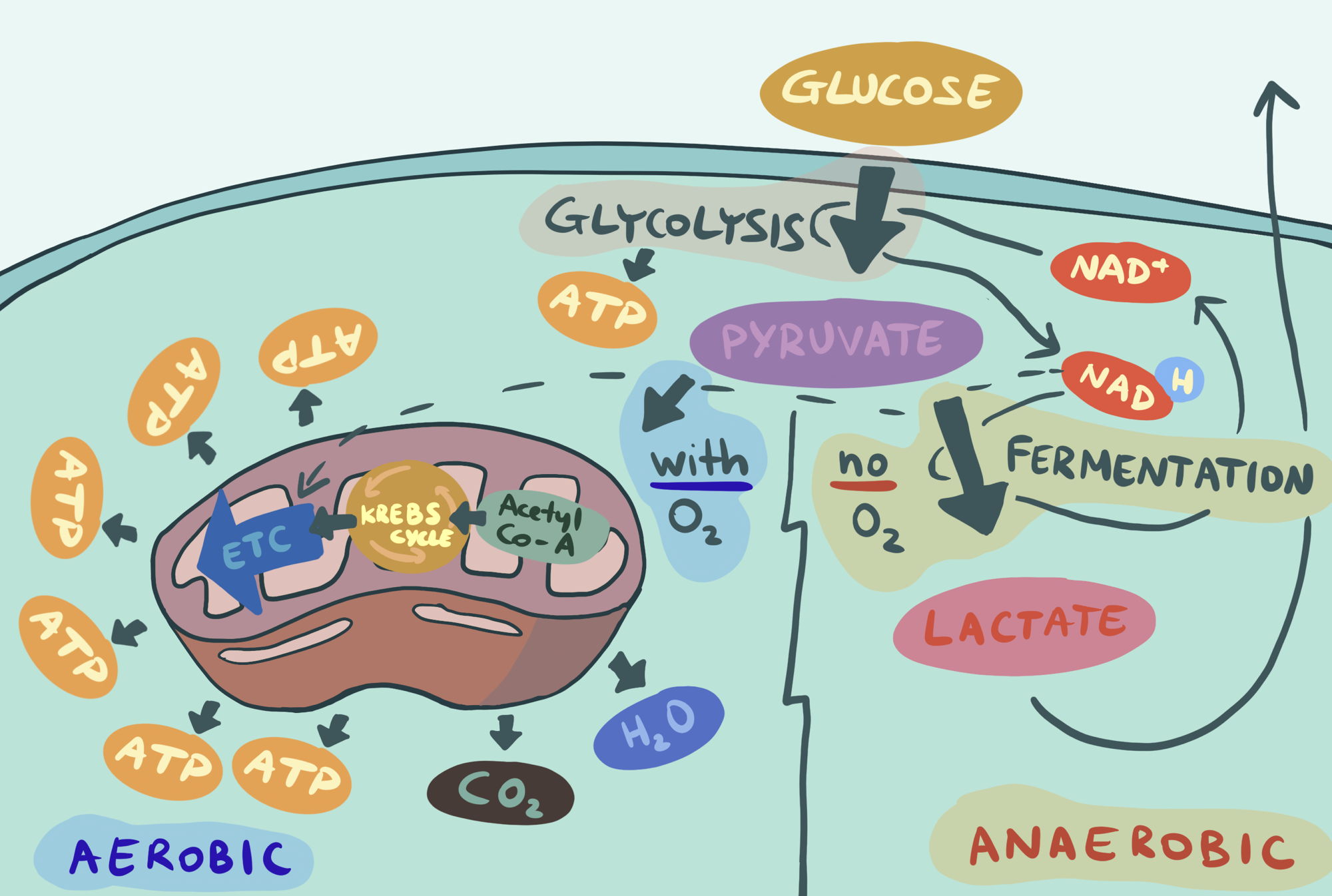
    2. In the presence of oxygen: Pyruvate is converted into Acetyl-CoA (the fats and proteins are converted into it, too – but for simplicity, in this article we will only consider glucose) inside the mitochondria, where it enters the Krebs cycle (yes, that beautiful metabolic monstrosity), and drives an electron transport chain that also uses NADH, the byproduct of glycolysis. This results in the reaction generating ATP which the inverse of the reaction we’ve seen in the beginning:

    ADP + PATP

    The amount of ATP per one glucose molecule generated in the aerobic metabolism is around 15 times more than during anaerobic glycolysis.
    The byproducts of the reaction are CO2 (which we eventually need to exhale) and water.
    Given the steady supply of oxygen, the aerobic path is a prevalent way for generating ATP. Usually anaerobic and aerobic pathways work together, though.

    Anaerobic and aerobic metabolism pathways in the cell. Mitochondria doing all this hard work! Image credit: Nuriya Nurgalieva, 2025.

    Heart rate zones

    How does heart and heart rate compute into this? The heart is the muscle which pumps blood which brings oxygen to your other muscles; in particular, the oxygen supply is proportional to the heart rate. The better the heart is trained, the more oxygen it can supply for the aerobic metabolism.

    Heart rate zones. Image credit: Nuriya Nurgalieva, 2025.

    As you run faster, your muscles contract faster, calling for more ATP, which in turn raises the oxygen demand. Heart rate rises. If the intensity of the exercise increases further, the role of anaerobic metabolism increases. The heart rate simply mirrors the metabolic intensity of the exercise. It is usually divided into standard 5 zones, computed relative to a maximal heart rate (the exact zones are very individual, this is just for the approximate calculation):

    • Zone 1 (50-60% of max heart rate): entirely aerobic, low stress, low lactate; good for recovery.
    • Zone 2 (60-70% of max heart rate): entirely aerobic, improves fat metabolism, increases number of mitochondria in the cell; easy run pace and building the aerobic base.
    • Zone 3 (70-80% of max heart rate): anaerobic metabolism starts to step in; lactate is still relatively low, and manages to be cleared out pretty quickly before accumulating (in fact, it can be cleared out and be reused in the liver as a glucose source!); tempo run base, comfortably hard and long race pace (20km+).
    • Zone 4 (80-90% of max heart rate): aerobic metabolism at its max, anaerobic contributes significantly, lactate accumulates and its levels reach so-called lactate threshold: it cannot be cleared as fast as it builds up; this results in the glycolysis slowing down and within few minutes, you will have to stop. Your lactate threshold indicates your metabolic limit for sustainable aerobic work. Threshold runs and longer intervals pace; a shorter race pace (5-10km).
    • Zone 5 (90-100% of max heart rate): anaerobic glycolysis rules! also, creatine phosphate contributes. Good for increasing VO2max – the maximum amount of oxygen your body can use per minute during intense exercise, often used as one of the performance markers, along with lactate threshold. Very hard and short intervals.

    Training and training interventions

    The running portion of the training incorporates two main elements:

    • building an aerobic base in Zone 2 and Zone 3;
    • improving lactate threshold and VO2max by doing intervals reaching into Zones 4 and 5 = X minutes fast, then Y minutes at slow/easy pace; run, repeat. The changes happen due to: your heart getting stronger, increasing the amount of blood pumped per beat; various pathways signaling for the need for more mitochondria (main aerobic energy supplier); and more proteins generated that slow down the lactate buildup. You can do intervals on a flat surface, or on an inclined one. I personally find uphill intervals very useful – they minimize mechanical impact while requiring more force and driving your heart rate higher.

    Supplementary interventions include (in no particular order):

    • strength training: increases muscle stiffness (in a good way), reducing the metabolic cost of movement; improves neuromuscular control; prevents injuries by strengthening tendons and joints. also, if you like running uphill like me, more force is required per step. If you don’t want the lactate to build too fast, it is important to make your muscles more efficient.
    • fatigue resistance training: doing intervals or short strides towards the end of your run rather than in the beginning, improving your performance when you are already in a slightly fatigued state. For example, these can be short strides
    • recovery: most of the bodily adaptations happen when the body is at rest, so let it rest after exercise. Muscles are repaired, glycogen stores replenished, new mitochondria are synthesized. Rolling out your sore muscles also helps massively!
    • cross-training: running is a high-impact sport with injury risks. Aerobic base can also be build by biking, working out on an elliptical, step master or – the middle ground – an uphill treadmill. I personally prefer the latter – you can start at 5% incline, and work your way to 8-10%. Mind your heart rate, not the treadmill speed!
    • heat training: exposing yourself to a heat stress for a short period of time increases your blood volume which leads to various positive adaptations as blood is the substrate transporting oxygen, glucose and lactate. You can do it passively (sauna) or actively (exercising slightly overdressed).
    • if you love trails – run downhill. Sadly, the muscular particulates of running downhill can only be trained by actually running downhill (unlike uphill running, which can also be somewhat mimicked by biking uphill). Just don’t destroy your knees!
    • snack and fuel yourself accordingly to your training! You should not train from the point of glycogen and energy deficit – remember, the training is primarily aimed at improving your ATP production (more mitochondria!) and neuromuscular response and cardiovascular ability. If your aim is to lose weight, you will lose it anyway as the body continues to adapt to the training. There is no need to starve yourself. Especially if you are a female runner – our fat oxidation is already better than men’s who can benefit from some fasted-state training. Just read up on how eating disorders have affected young runners (both male and female, but mostly female) in 2000s (for example, Lauren Fleshman’s Good for a Girl). It is no fun.
    • again, fuel during long runs! Find whichever gel that works for you, and slurp away (or gummy bears, or any other easily digestible sugars). The minimum I take is 40g of carbohydrates per hour. For longer ultra level races, some protocols recommend up to 120 g per hour. Your body needs that glucose!
    • hydration: to restore the salt balance of the body – we lose a lot while sweating.
    • protein: while of course runners are not the same as weightlifters, we still need to take note of the protein we’re intaking. Protein consumed with carbs improves glycogen synthesis; prevents muscle loss (especially for long distance runners!); and supports immune system function (running suppresses your immune response). In fact, you have to increase your protein intake even on your rest days (see last year’s study).

    Running is great for my discipline, grounds me emotionally, and (a nice bonus!) the exercise science behind it is super interesting, too. I hope you found something useful here to enjoy your runs!

    What I listen to on long runs

    Mostly music or podcasts. My top recommendations are

    • < Some Work, All Play
      — a running-focused podcast by two ultrarunners who discuss training, science and their lives.
    • Heart Starts Pounding
      — a podcast discussing real mysteries, crimes and strange disappearances.
    • The Bright Sessions
      and
      The Magnus Archives
      — audio dramas (for sci-fi, fantasy and horror lovers!). The Bright Sessions follows a therapist who specializes on the most unusual patients, and Magnus Archives contains stories from a mysterious archive which might – or might not – be connected in a larger sinister plot.
    • The Ezra Klein Show
      — Ezra Klein from NY Times discusses modern US politics.
    • Critics at Large
      — three critics from The New Yorker take on the newest trends in cinematography and culture.

    In the future installments of these series, I will attempt to break down the mechanics of how exactly different training interventions work on the biochemical and biomechanical levels. Please let me know in the comments below if there is one you’re particularly interested in!

  • Sign design by Lisa Heierli (Science Lab UZH), 2025.

    Everyone has heard about quantum mechanics by now. But it remains a mystery for many, a placeholder for something impossibly complicated, a synonym to “rocket science”. So what happens if we stop treating quantum physics as something untouchable and turn it into a game?

    For the past year and a half, I’ve been helping build something a little unusual at the University of Zürich: a quantum-physics–inspired escape room that lets you step straight into a century of scientific ideas.

    To celebrate the 100th anniversary of quantum theory, the Quantum Century Escape Room will transport you back to the 1920s— when quantum mechanics was just born. As the countdown begins, your team must crack puzzles, connect clues, and tackle hands-on challenges to uncover the secret of a mysterious scientist from the early days of quantum physics, whose long-forgotten office has just been “rediscovered” in the basements of the University of Zürich.

    And here’s the best part: you don’t need to know any physics to play! The escape room is designed for curious minds of all backgrounds and shines a spotlight not only on famous discoveries, but also on the often-overlooked scientists and inventors who helped shape modern physics.

    Turning this idea into reality was an adventure on its own, filled with trials and tribulations – from coming up with puzzles and storylines to designing the room’s visual world, building and testing interactive elements, and making sure everything works when players enter the room. I’m proud to have contributed to the concept, coordination, and visual design—and I’m even more excited to finally share it with you.

    This project was made possible thanks to a fantastic UZH-wide collaboration: the Department of Physics, the Physics Workshop, Science Lab UZH, and many wonderful colleagues. We are also grateful for partial support from the Swiss National Science Foundation SNSF Agora programme, which helped bring this idea to life.

    🔓✨ Bookings for next year are now open—come explore quantum mysteries at the Science Pavilion UZH! 🔗 Book your visit here.

  • I don’t think I need to explain that something horrible happened to my world in February 2022. Of course, horrible things happen all the time, but we often choose to ignore them. We [people residing in the West] are used to thinking that the age of wars is over, left in the previous century. There are many who would disagree – Syrians, Afghans, Serbian, Chechen – the list goes on and on, but it is convenient to forget. We are far enough; these are not our people; we don’t feel responsible.

    I was born and raised in Russia, and lived there until I was twenty. I grew up to my parents always leaving Echo of Moscow on; that’s a radio station which was always more opposed to the government than the others (of course, it was shut down in 2022 following their coverage of the war). I think that the criticism I’ve been exposed to through their radiowaves played a large part in my strained relationship with my the government. I don’t think a lot of my generation do — perhaps, this part is my wishful thinking; perhaps, a more precise statement to make is my friends do not support the war.

    I love my country very much, but I hate the state, Lumen‘s lead vocalist shouted in the early 2000s in the songs we listened to, way before mass protests, anti-LGBT laws, anti-adoption laws, Crimea and Ukraine and the mass murder of independent media.

    I felt that sentiment hundred times stronger when Russia attacked Ukraine.

    I am immensely proud of all my peers who have courage to resist from inside the country. They are true contemporary heroes even if labelled villains by the state.

    As for me – I needed an outlet for the shame that I felt on behalf of someone who didn’t seem to have any shame at all, and my humanitarian contribution was to help out with translation and giving the directions for the refugees on the Zürich main station. This was effectively my second job for two and half months in the spring, which I did whenever my doctoral studies allowed. It was extremely rewarding, and I have met many amazing people while doing it. I also hope I have managed to make – however small – a difference.

    So here go few tips for volunteers from the experience I’ve gathered, most of them subjective and rely on my point of view and my personality, but maybe some of you would find them helpful! They mostly concern myself and my relationships – with the refugees and other volunteers.

    Refugees and yourself.

    You are a human, with your own emotions and your own opinions. These are not relevant for your service; what is relevant is your ability to empathise, and be clear and direct in your instructions. People that are approaching you are in need of help, not judgement; your personality should not appear in the equation between you and them.

    You must show the same friendly face to different, very different people of different backgrounds, different beliefs, different opinions, different religions. Control your reactions; don’t take anything personally. Sometimes people say hurtful things, and that is their trauma speaking, not them.

    You don’t have a right to react in any way but a compassionate one. You are the mirror in which they seen their suffering and pain, and it has nothing to do with who you are.

    You are also, for a short time, a rock that people can rely on.

    It is hard to be individually empathetic when a lot of people come in. Still, try. Still, greet everyone with a smile. Still, say how glad you are that they are all here. Still, remember about the reason you came here.

    A good mantra is “I came here to help these people, because everyone deserves to get the help they need.” Your reasoning layers can be a bit different from that: for example, “I feel ashamed of what the country I’m a citizen of has done, and I feel the need to make amends”, or “My fellow citizens are targeted by a maniac dictator with delusions of grandeur, and it’s my duty to resist in the ways I can.” But, in the end, it all comes down to the empathy and compassion you have. And the lesson I have learnt, is that when you’re kind to people, (in most cases!) they are also kind to you.

    Other volunteers.

    You all agree: the war is a horror with terrifying consequences. You may disagree on many different things; in fact, you will disagree on many different things. They are not relevant. These people, just like you, have dedicated their time and effort and mental strength to the cause, and you have to respect them for that. They are your colleagues, your partners in arms, their empathy your shared resource, and you have at least one thing in common.

    Mental health.

    This is a job, like any other. You can become a workaholic with this one, too. You have to remember — there are hard limits on your mental and emotional capacity. You are the only one who knows these limits, and the only one who can stop yourself to take a deep breath and a break. You are more of use to people when you are rested and healthy, not when you are on a verge of a burnout.

    Volunteering has an emotional aspect to it, and too much emotion can drain you quickly. Sometimes, people want to tell a story. Most of the times, these stories are casually horrible. Be prepared to take it, and if you think you cannot — quietly ask one of your colleagues to help you out.

    Sadly, the world is still a dark, cruel, unforgivingly irreversible place – even more so in the last few years. But we still have one another, and sometimes it’s just enough light to keep you company in the darkness.