“Seek freedom and become captive of your desires. Seek discipline and find your liberty.”
― Frank Herbert, Chapterhouse: Dune
Would 15 year old myself — who skipped PE class on most of the days — have ever imagined writing this post? Probably not. I think even my 25 year old self would not believe me hyping up the grind of the running, and you know, it’s ok. One could say it is a mark of character development, served with a side of a life crisis of a millennial, and seasoned with a dash of losing control over the global narrative of events. Running has become my meditation and the time I share with my mind, my body and nature.
I have been running on and off for around five years or so, and much more intensively and intentionally in the last two years. My poison of choice is long distance and trail running – it turns out I quite enjoy suffering in a controlled manner for a long periods of time. I started knowing almost nothing, and now I know a bit more, so I want to share my intermediate findings. I hope you find something useful for yourself!
Disclaimer: I don’t mean to be an expert — this is a learning process for me, too, and sometimes I will simplify (but hopefully not oversimplify!) the science. It is also an excuse to draw some pretty diagrams 😉
Biochemistry of running
Before I get into the bits about training, l will review the chemistry of running (exercise, in general) which would then tie into various training interventions and hopefully help with their understanding.
Running requires energy. Energy, in the language of the body chemistry, is the ATP molecule (adenosine triphosphate). As the name suggests, it contains one adenosine group, and three phosphate groups. Muscle contraction necessary for running (and many other activities) happens via the help of a myosin. It is a small protein basically driving the contraction, which belong to a class of motor proteins. If you ever studied anything to do with biology, you must have seen the famous walking gif of a related motor protein kinesin:

ATP (adenosine triphosphate) → ADP (adenosine diphosphate) + P (a lonely phosphate group) + energy
Myosin does not care where ATP comes from as long as it can find it in the cell’s cytosol, swimming somewhere in the cytoplasm. How does it get it, use it and sustain it?
When you just start moving, the body can use the small amount of ATP already floating in your cytosol. It can even reuse ADP, the byproduct of it breaking, by taking advantage of phosphate creatine PCr stored in the muscles and reattaching the phosphate group:
ADP + PCr → ATP + Cr (creatine)
This pathway of ATP regeneration is anaerobic (does not require oxygen), produces a very high power output, and is optimal for sprinting, jumping, power lifting, and other activities requiring a short burst of power. It cannot last because PCr stores in muscles are emptied within the first 10-20 seconds of the activity. With more training, and creatine supplements, the volume of stored PCr can be increased.
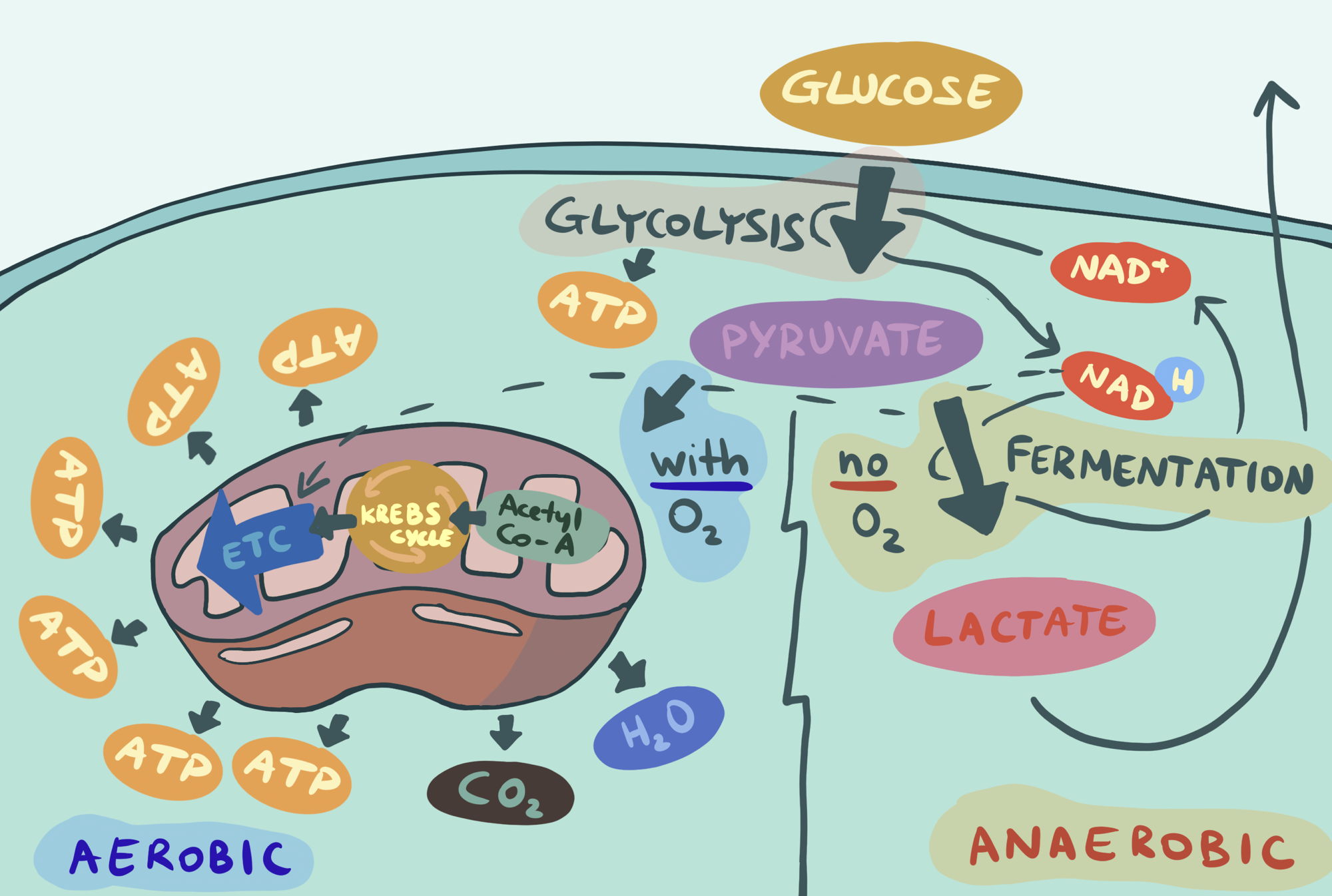
Otherwise, more ATP is obtained from processing glucose from glycogen stored in the muscle, the liver, fatty acids from intermuscular fat, and amino acids (proteins). The glucose undergoes the reaction of glycolysis which converts it into ATP:
Glucose + 2 ADP + 2 P + 2 NAD+ →
2 Pyruvate + 2 ATP + 2 NADH + 2 H2O
At the heart of this reaction, we have NAD+, which is an oxidized form of the molecule of Nicotine Adenine Dinucleotide, missing an electron. It is essential for the reaction of glycolysis. It can be regenerated from NADH in two ways:
1. In the absence of oxygen (the reaction of fermentation):
2 Pyruvate + 2 NADH → 2 Lactate + 2 NAD+
At high intensities of exercise it cannot keep up – the free protons H+ released during the reaction lower the pH of the muscle and limit the catalysis of the glycolysis reaction itself. Lactate and H+ collecting in the muscle contribute to a burning sensation during short running intervals. That is, this anaerobic pathway cannot be sustained on its own for longer than 30-120 seconds.
2. In the presence of oxygen: Pyruvate is converted into Acetyl-CoA (the fats and proteins are converted into it, too – but for simplicity, in this article we will only consider glucose) inside the mitochondria, where it enters the Krebs cycle (yes, that beautiful metabolic monstrosity), and drives an electron transport chain that also uses NADH, the byproduct of glycolysis. This results in the reaction generating ATP which the inverse of the reaction we’ve seen in the beginning:
ADP + P → ATP
The amount of ATP per one glucose molecule generated in the aerobic metabolism is around 15 times more than during anaerobic glycolysis.
The byproducts of the reaction are CO2 (which we eventually need to exhale) and water.
Given the steady supply of oxygen, the aerobic path is a prevalent way for generating ATP. Usually anaerobic and aerobic pathways work together, though.

Heart rate zones
How does heart and heart rate compute into this? The heart is the muscle which pumps blood which brings oxygen to your other muscles; in particular, the oxygen supply is proportional to the heart rate. The better the heart is trained, the more oxygen it can supply for the aerobic metabolism.

As you run faster, your muscles contract faster, calling for more ATP, which in turn raises the oxygen demand. Heart rate rises. If the intensity of the exercise increases further, the role of anaerobic metabolism increases. The heart rate simply mirrors the metabolic intensity of the exercise. It is usually divided into standard 5 zones, computed relative to a maximal heart rate (the exact zones are very individual, this is just for the approximate calculation):
- Zone 1 (50-60% of max heart rate): entirely aerobic, low stress, low lactate; good for recovery.
- Zone 2 (60-70% of max heart rate): entirely aerobic, improves fat metabolism, increases number of mitochondria in the cell; easy run pace and building the aerobic base.
- Zone 3 (70-80% of max heart rate): anaerobic metabolism starts to step in; lactate is still relatively low, and manages to be cleared out pretty quickly before accumulating (in fact, it can be cleared out and be reused in the liver as a glucose source!); tempo run base, comfortably hard and long race pace (20km+).
- Zone 4 (80-90% of max heart rate): aerobic metabolism at its max, anaerobic contributes significantly, lactate accumulates and its levels reach so-called lactate threshold: it cannot be cleared as fast as it builds up; this results in the glycolysis slowing down and within few minutes, you will have to stop. Your lactate threshold indicates your metabolic limit for sustainable aerobic work. Threshold runs and longer intervals pace; a shorter race pace (5-10km).
- Zone 5 (90-100% of max heart rate): anaerobic glycolysis rules! also, creatine phosphate contributes. Good for increasing VO2max – the maximum amount of oxygen your body can use per minute during intense exercise, often used as one of the performance markers, along with lactate threshold. Very hard and short intervals.
Training and training interventions
The running portion of the training incorporates two main elements:
- building an aerobic base in Zone 2 and Zone 3;
- improving lactate threshold and VO2max by doing intervals reaching into Zones 4 and 5 = X minutes fast, then Y minutes at slow/easy pace; run, repeat. The changes happen due to: your heart getting stronger, increasing the amount of blood pumped per beat; various pathways signaling for the need for more mitochondria (main aerobic energy supplier); and more proteins generated that slow down the lactate buildup. You can do intervals on a flat surface, or on an inclined one. I personally find uphill intervals very useful – they minimize mechanical impact while requiring more force and driving your heart rate higher.
Supplementary interventions include (in no particular order):
- strength training: increases muscle stiffness (in a good way), reducing the metabolic cost of movement; improves neuromuscular control; prevents injuries by strengthening tendons and joints. also, if you like running uphill like me, more force is required per step. If you don’t want the lactate to build too fast, it is important to make your muscles more efficient.
- fatigue resistance training: doing intervals or short strides towards the end of your run rather than in the beginning, improving your performance when you are already in a slightly fatigued state. For example, these can be short strides
- recovery: most of the bodily adaptations happen when the body is at rest, so let it rest after exercise. Muscles are repaired, glycogen stores replenished, new mitochondria are synthesized. Rolling out your sore muscles also helps massively!
- cross-training: running is a high-impact sport with injury risks. Aerobic base can also be build by biking, working out on an elliptical, step master or – the middle ground – an uphill treadmill. I personally prefer the latter – you can start at 5% incline, and work your way to 8-10%. Mind your heart rate, not the treadmill speed!
- heat training: exposing yourself to a heat stress for a short period of time increases your blood volume which leads to various positive adaptations as blood is the substrate transporting oxygen, glucose and lactate. You can do it passively (sauna) or actively (exercising slightly overdressed).
- if you love trails – run downhill. Sadly, the muscular particulates of running downhill can only be trained by actually running downhill (unlike uphill running, which can also be somewhat mimicked by biking uphill). Just don’t destroy your knees!
- snack and fuel yourself accordingly to your training! You should not train from the point of glycogen and energy deficit – remember, the training is primarily aimed at improving your ATP production (more mitochondria!) and neuromuscular response and cardiovascular ability. If your aim is to lose weight, you will lose it anyway as the body continues to adapt to the training. There is no need to starve yourself. Especially if you are a female runner – our fat oxidation is already better than men’s who can benefit from some fasted-state training. Just read up on how eating disorders have affected young runners (both male and female, but mostly female) in 2000s (for example, Lauren Fleshman’s Good for a Girl). It is no fun.
- again, fuel during long runs! Find whichever gel that works for you, and slurp away (or gummy bears, or any other easily digestible sugars). The minimum I take is 40g of carbohydrates per hour. For longer ultra level races, some protocols recommend up to 120 g per hour. Your body needs that glucose!
- hydration: to restore the salt balance of the body – we lose a lot while sweating.
- protein: while of course runners are not the same as weightlifters, we still need to take note of the protein we’re intaking. Protein consumed with carbs improves glycogen synthesis; prevents muscle loss (especially for long distance runners!); and supports immune system function (running suppresses your immune response). In fact, you have to increase your protein intake even on your rest days (see last year’s study).
Running is great for my discipline, grounds me emotionally, and (a nice bonus!) the exercise science behind it is super interesting, too. I hope you found something useful here to enjoy your runs!
Mostly music or podcasts. My top recommendations are
-
< Some Work, All Play
— a running-focused podcast by two ultrarunners who discuss training, science and their lives. -
Heart Starts Pounding
— a podcast discussing real mysteries, crimes and strange disappearances. -
The Bright Sessions
and
The Magnus Archives
— audio dramas (for sci-fi, fantasy and horror lovers!). The Bright Sessions follows a therapist who specializes on the most unusual patients, and Magnus Archives contains stories from a mysterious archive which might – or might not – be connected in a larger sinister plot. -
The Ezra Klein Show
— Ezra Klein from NY Times discusses modern US politics. -
Critics at Large
— three critics from The New Yorker take on the newest trends in cinematography and culture.
In the future installments of these series, I will attempt to break down the mechanics of how exactly different training interventions work on the biochemical and biomechanical levels. Please let me know in the comments below if there is one you’re particularly interested in!
Leave a Reply